Tuesday, January 7, 2020
The Wizard's Hat
There was once a Wizard. He lived in a small town by the sea where he owned a wizarding shop. There was a sign over the door with “Wizard” painted in gold, curly letters. Inside the walls were lined with dusty shelves, overflowing with ancient books, and jars of spells and potions. The floor and ceilings were covered with strange, mystical symbols - pentagrams and octograms and other-sorts-of-grams. The Wizard himself lived in some small but well-appointed rooms above the shop.
The Wizard was, for the most part, everything you might expect a Wizard to be. He had thick, bushy eyebrows, and a beard that flowed down to his waist. He had a wand that glowed blue in the dark and left a trail of sparkles when he swished it, and his robes were long, the colour of midnight, and embroidered with hundreds or silver stars and moons. His hat had a wide brim and would have, been tall and pointy, but, and it was a big BUT, the point always flopped over.
Of course this is a big deal for a wizard. You wouldn’t go to a wizard without a pointy hat, and neither would I. When he walked down the street, children would laugh behind the Wizard’s back, and throw stones at him, not being the least worried that he would turn them into a newt, or a duck, or a bowl of clam chowder.
The Wizard tried everything he could think of to make the point of his hat stand up: he starched it; he stuffed it with straw; he reinforced it with sticks and cardboard, but all to no avail. No matter what he did, his hat would not stay pointy.
One day, while the Wizard was sitting behind the counter of his shop drinking green tea, the mail arrived. There was the usual collection of bills and catalogs, but, at the bottom was an invitation to sit on a panel on advanced disenchantments at the Annual North-East Regional Wizarding conference the next week. At first the Wizard was very excited. The conference was always a great place to see the latest wizarding parapharnalia, try out new beard-conditioning products, and catch up with old friends and colleagues, and to be invited to take part in a panel would be an honor. But then he hesitated; how could he take part when the point of his hat flopped over so. Sadly he decided he would have to decline the invitation.
Feeling despondent, the Wizard decided to go for a walk in the enchanted forest that bordered the town (in those days there were many more enchanted forests, and fewer enchanted shopping malls about). As he walked he tried to imagine what other wizards would say, seeing his floppy hat, and how he could possibly attend and be taken seriously.
After he had been walking for a little while, the Wizard heard a sound of crying through the woods. He followed the sound till he came to a grass-covered glade. In the middle of the glade lay a white unicorn with rainbow tears flowing from her eyes.
“What’s the matter?” asked the Wizard.
“My hoof hurts,” sobbed the Unicorn.
“Let me look,” said the Wizard. He came closer and examined the beast’s hoof. “There’s a stone in it. I’ll soon have it out,” he said.
He took out his special edition wizard’s swiss army knife (one big blade, one little blade, scissors, bottle opener, and a miniature, telescoping wand for emergencies) and removed the stone.
The Unicorn jumped up and started prancing round the glade. She popped a passing bubble with her horn. (Most evolutionary biologists believe that unicorn horns are a means of defence, but, the truth is, they evolved them solely for the purpose of bursting bubbles, which is a favorite pastime of unicorns.) She tossed her head and whinnied.
After a little while the Unicorn paused and looked at the Wizard. “You look sad,” she said. “What’s the matter?”
The Wizard explained about the Annual North-East Regional Wizarding conference, and about his floppy hat.
The Unicorn thought for a minute. “You know,” she said, “we unicorns lose our horns every winter, and grow new ones in spring.”
“Of course,” said the Wizard who had studied unicorns and other mythical creatures in wizarding school (but didn’t understand about the bubbles.)
“I think I still have my horn that fell off last winter,” she said. “We could try that.”
The Unicorn left the glade, and returned a few minutes later carrying a large and very pointy horn in her teeth.
We the help of the Unicorn and a roll of duct tape, the Wizard fastened the horn to his head. He put the hat over it. The point stood up, sharp and true. The wizard returned home with a spring in his step, to admire himself in the mirror.
And so, the following week, the Wizard attended the Annual North-East Regional Wizarding conference. He examined the latest wizarding paraphernalia. He tried out several new beard conditioning products, but decided to stick with his old standby. He spoke eloquently and authoritatively at the panel on dissenchantments. And, at the end of the conference, after the awards for most-innovative new spell, and for special services to wizarding where awarded, the organizing committee presented him with the annual award for pointiest hat.
The Wizard proudly carried the trophy back to his shop, and placed it on the shelf behind the counter, between the books on dragon-calming and invisibility spells, so that it would be the first thing that anyone coming into the shop would see.
Friday, October 18, 2019
The Emperor and the Bird
She was nothing special to look at. She had a small pointed beak, black eyes that moved constantly, and her feathers were brown and ordinary. She lived in an ordinary looking nest, in an ordinary looking tree. But she had the most beautiful voice in the whole forest.
Sometimes the little bird would watch the bright blue jays and scarlet cardinals flitting from tree to tree, and she would wish she were as brightly coloured as them. Then she would sing a sad song, and all the forest creatures who heard her, the foxes and stoats, the chipmunks and field mice, would feel their hearts fill with mourning, and would cuddle up with their young in their nests and burrows.
Sometimes the bird would watch the sunrise over the forest, and she would sing a song of joy at it’s beauty and splendor. Then the forest creatures would play and frolic in the fields, and they would go about their days with their tails held high and their ears pricked up, full of excitement about the coming day.
Sometimes the bird would watch the sunlight glinting of the towers of the palace in the distance, for in those days the land was ruled over by a great and wise Emperor, and his palace was magnificent, with gardens full of fountains and blossoming fruit trees. Then she would sing songs of wonder, and the forest creatures would stop and gaze into the distance, their hearts full of curiosity and wonder at the world.
Now it came to pass that one day the Emperor decided that it was time to appoint a new High Chancellor: “For I am getting old,” he said, “and the work of an emperor is hard. I need help to rule justly and fairly”.
Of course all his officials, advisors and noblemen argued that they should get the job. They all came before him, flattering and obsequious, deriding their rivals and making cases for why they should be they should be the new High Chancellor.
“Very well,” said the Emperor, for he quickly tired of such flattery and noise. “In one month, any who wishes to be my High Chancellor may bring a bird to me in the Imperial Gardens. He who brings the bird that pleases me most will be my new High Chancellor.”
At once all the advisors left to find the most fantastic birds they could. Some went to the markets to buy the rarest birds they could: bright yellow canaries, scarlet macaws, and beautiful peacocks with green iridescent feathers. Some chartered ships and sailed far and wide looking for even stranger birds. One bought back an ostrich from Australia, one a dodo from Mauritius, and one went as far as Norway and bought back a parrot with beautiful blue plumage.
Now in the palace there lived a poor servant boy. He had been born on a farm, but he was lame and his family was very poor and couldn’t afford to feed and clothe him, and so had sent him to the palace to try to find work. There he worked in the kitchens, or ran errands for various lesser noblemen, and, since he worked hard and stayed out of trouble, he managed to get by. Still he watched all the important men and women coming and going from the palace, seeking audiences with the emperor, and wished for more from his life. “If I had a great bird,” he thought, “I could get in to the Imperial Gardens and see the Emperor myself. I would serve him well.” But he could not travel far and had no money to buy a bird from any of the merchants in the town.
And so a month passed, and one day, being done with his chores for the day, the boy went out for a walk in the forests beyond the great palace. As he stood in thought, he saw the small brown bird alight on a branch near him.
“If you were to come with me,” he said, “we could enter the Imperial Gardens of the palace. We might even see the Emperor. For he has decreed that anyone with a bird can come to the palace today, and he will choose whosoever has the bird that pleases him the most tho be his High Chancellor.”
Of course the bird wanted to see the palace and the Imperial Gardens more than anything, and so she flew down to perch on the boy’s shoulder, and together they headed back to the palace.
The Imperial Gardens were alive with the chatter of officials, advisors and noblemen, all clamoring for the Emperor’s attention, mixed with the squarks and cries or a hundred different birds from all corners of the world.

The Emperor walked amongst them looking at each in turn. He saw the peacock with its magnificent tail feathers. “Too showy,” he said dismissively, “it can hardly fly”. He saw the fat dodo, with its enormous, bulbous beak. “Ridiculous,” he said, “How does such a creature survive?”. As he approached the ostrich it put its head in the ground and turned invisible. The lovely plumage of the blue parrot caught his eye, but as he came to look he was surprised to see that it did not move. He prodded it with his finger and it fell off its perch, dead.
And so he went from one bird to another, each more strange and marvelous than the last. But quickly he grew weary, for he found them all wanting, and somehow none pleased him.
The small brown bird watched quietly from her perch on the boys shoulder, wishing that she could be as graceful, or as splendid or as exceptional as these strange and wonderful creatures, and she started to sing a sad and mournful song.
Throughout the gardens, everyone fell silent, their hearts suddenly filled with a longing for things that might once have been, and things that could never be. The old Emperor felt a tear come to his eye.
But then the bird looked out at the blossoming cherry trees and the sparkling fountains, and she sang a different song - one of joy and wonders.
Throughout the gardens, all who heard felt their souls rise up, filled with joy. Suddenly the old Emperor felt the weight of the years of responsibility and lifted from his shoulders, and recalled the joy and vigor of his youth. He rose up tall and straight. “Where is the bird that sings this song?” he said. “Bring it to me.”
The servants and courtiers rushed about, trying to find the source of the song, and finally the boy was bought before the Emperor, the small bird still perched on his shoulder.
First the Emperor turned to the bird. “There is more beauty in your song than all these others put together,” he said. “Please will you come to live in my gardens, and sing your songs for me and my visitors?”.
Then he turned to the boy. “You have shown more wisdom and judgement than all these others,” he said. “You will make a fine High Chancellor”.
And so it came to pass. The boy served the Emperor as High Chancellor for many years, and helped him to rule wisely and well. When the Emperor finally passed, the High Chancellor remained, advising his heirs, until he too grew very old, and the people of the land lived happily in peace and prosperity.

In the Imperial Gardens, the small, brown bird lived out her life, singing her songs. She lived long and had many chicks, each of whom sang just as sweetly as she did. And they too had chicks, so that the air of the gardens was always full of song.
Visitors would come from far away lands to seek an audience with the Emperor, and would walk amongst the Imperial Gardens, and always they would return home telling tales of the splendors and marvels they had seen, but, especially, of the songs of the Emperor’s birds.
Saturday, June 29, 2019
The Very Muddy Hippopotamus
Once there was a very muddy hippopotamus. She liked to spend her days wallowing in her favorite mud hole. She would roll in the mud. She would squish the mud between her toes. She would sing songs about the mud. She only left to go to the river and and drink, or to get food. And, whenever she left the mud hole, she would always be covered, from the tips of her ears to the end of her tail, in thick, gooey mud.
The other animals in the jungle were not happy with the hippopotamus. The birds, the swallows and flamingos, complained that she would get mud on their lovely feathers. The leopard complained that she would get mud on her elegant spots. The tiger complained that she would get mud over his splendid stripes. Even the antelope complained that she would get mud on her silky, fawn fur (before noticing that she was sharing a paragraph with a tiger and promptly being eaten).
What the other animals did not know was that the hippopotamus had a secret: underneath the mud her skin was a bright, shocking pink. Of course the hippopotamus was very shy about this. “If the other animals see that I’m pink, they’ll all laugh at me,” she thought. And so, whenever she left her mud hole, she would make sure she was completely covered in thick, gooey mud.
One day a fairy queen came to the jungle to see how the animals were getting along.
All the animals complained about the very muddy hippopotamus. The tiger complained about getting mud on his splendid stripes. The leopard complained about getting mud on her elegant spots. The storks and the flamingos complained about getting mud on their lovely feathers. Even an antelope complained about getting mud on her silky, fawn fur. (This was another antelope who was carefully staying at the opposite end of the paragraph from the tiger).
The fairy queen listened to all the animals grumbling, and then she waved her wand to create a magical hippopotamus washer. There were round, whirling brushes that would scrub the mud off the hippopotamus’ sides. There was another whirling brush that would come down from above and scrub the hippopotamus’ back. There were nozzles that would go back and forth, spraying the hippopotamus with warm, soapy water. There were more nozzles to rinse the hippopotamus with clean water, and more whirling brushes with towels attached to dry her off afterwards. There was even a conveyor belt which would carry the hippopotamus between the whirling brushes and spraying nozzles before she knew what was happening. (The fairy queen decided against including the magical under-body hot wax spray).
And so, the next day, when the hippopotamus left her mud hole to go to the river, she stepped onto the conveyor belt and the magical hippopotamus washer started up. Suddenly there were whirly brushes scrubbing her and nozzles spraying her from directions. Before she knew it the mud was all gone and, the hippopotamus was standing, bright pink, in the middle of the jungle.
The fairy queen listened to all the animals grumbling, and then she waved her wand to create a magical hippopotamus washer. There were round, whirling brushes that would scrub the mud off the hippopotamus’ sides. There was another whirling brush that would come down from above and scrub the hippopotamus’ back. There were nozzles that would go back and forth, spraying the hippopotamus with warm, soapy water. There were more nozzles to rinse the hippopotamus with clean water, and more whirling brushes with towels attached to dry her off afterwards. There was even a conveyor belt which would carry the hippopotamus between the whirling brushes and spraying nozzles before she knew what was happening. (The fairy queen decided against including the magical under-body hot wax spray).
And so, the next day, when the hippopotamus left her mud hole to go to the river, she stepped onto the conveyor belt and the magical hippopotamus washer started up. Suddenly there were whirly brushes scrubbing her and nozzles spraying her from directions. Before she knew it the mud was all gone and, the hippopotamus was standing, bright pink, in the middle of the jungle.
The poor hippopotamus was so shy and embarrassed that she wanted to run away and hide. But then something strange happened. All the other animals started saying “ooh” and “ahh”. The tiger said how splendid his black and orange stripes would look next to the pink hippopotamus. The leopard said how elegant his spots would be against a bright pink backdrop. The stork said how lovely it would be with her feathers, and the flamingo was particularly impressed. Even the antelope seemed about to say how well pink would go with her silky, fawn fur, except that she was eaten by a lion before she could speak. (The lion hadn’t been mentioned in our story so far because she’d been hiding in the tall grass waiting to pounce the whole time.)
After that things changed for the hippopotamus. She would still spend most of her days wallowing in her favorite mud hole. She would still roll in the mud. She would still squish the mud between her toes. She would still sings songs about the mud. But now, whenever she left her mud hole, she would jump onto the conveyor belt of the magical hippopotamus washer, and then she would parade about the jungle, bright pink and as happy and proud as can be.
Monday, December 24, 2018
The Pigasus
By Sophie and Anthony
Sophie came up with the idea of a Pigasus, and it seemed like such a great idea that there had to be a story there. So I started with "Once there was a pigasus" and let it go where it would from there. Sophie thought it was good, and said she'd draw the pictures if I typed the story.
It turns out that the pigasus had lots more adventures during her travels, which are only hinted at here, and Rose and Sophie have been asking me to tell them about them at bed times for a while now. Perhaps I'll write up some of those too, if Sophie is willing to draw some more pictures for them.
Once there was a pigasus. She was small and round and pink (except, or course, when she’d been playing in the mud holes, when she was small and round and muddy brown). She had a round snout and floppy ears and a little curly tail. And, on her back, she had two large, white, feathery wings.
Her name was Oink, and she lived in a magical land, full of magical creatures. There were unicorns, and griffins, and trolls, and fairies, and a magical slug named Erold. But, so far as Oink knew, she was the only pigasus.
This meant that Oink was very busy. When a princess wandered down to the local frog pond, and a frog asked her for a kiss, she would invariably say “Not until pigs fly!”. At this point the frog would call up Oink, who would do a fly-over. “Oh well,” the princess would say, and bend down to kiss the frog. Then, in a poof of magic, the princess would turn into a frog, and the two would hop away to live happily ever after.
This sort of thing happened very often, which meant that Oink was always on call. But still she was lonely, and wanted, more than anything, another flying pig to play with.
And so, one day, Oink decided to set of in search of another pigasus. She packed up her belongings in a spotted red handkerchief, which she slung over her shoulder, and off she flew.
Oink flew many months; she flew many weeks (four weeks to the month you may mark). She flew over valleys and streams, forests and lakes, mountains and hills. She flew over the ocean to strange tropical islands, full of brightly coloured birds and screeching monkeys. She met flying horses, and flying squirrels, and even a flying penguin. (The penguin was in a hot-air balloon, but Oink thought that counted.) She was attacked by a huge giant with one eye, who tried to swat her out the sky, but fortunately the giant had very poor depth perception and missed.
And so, one day, tired and hungry, she landed in a village to drink from the public trough. The she noticed a poster on the wall:
One Night Only
THE CIRCUS!!!
Featuring:
Clowns
Jugglers
Acrobats
and…
THE FABULOUS PORCINI BROTHERS
FLYING PIGS!
Oink was very excited. Partly because she loved clowns and jugglers. But also because of the prospect of seeing flying pigs.
She checked the date and time on the poster. The circus was in a town five miles away and started in an hour. Though she was tired, she flew as fast as she could, and got there just in time.
The huge circus tent was almost full when Oink arrived and took her seat. The Ringleader entered, and, one after another he announced the acts, each one more fantastic than the last. There were clowns, who tripped over their enormous shoes, threw pies at one another, and landed flat on their faces. There were jugglers, who juggled balls, flaming torches, and then one juggler juggled two other jugglers, who in turn juggled flaming torches. And there were acrobats, and a lion tamer who put his head in the mouth of a lion, and then put the lion’s head in his own mouth.
Then the light dimmed, the crowd hushed, and the Ringleader announced, “And now, the moment you’ve all been waiting for…. THE FABULOUS PORCINI BROTHERS!”.
The lights shone reached up to the top of tent where, balanced on a small platform a hundred feet above the ground, stood two pigs. One pig took hold of a trapeze bar and swung from one side of the tent to another. The second pig took a turn, and the first caught him by the trotters and swung back again. The two pigs swung back and forth; jumping and twisting and turning somersaults in the air. They caught one another by the trotters, the ears, the tail.
Oink was spellbound. “They’re not actually flying pigs,” she thought, “but they really are amazing”.
When the show was over, Oink went round to the trailers parked behind the big tent. She found one with “Porcini Bros.” painted in gold, curly letters on the side, and knocked on the door.
A large, handsome pig opened the door. “Hello,” he said. “I’m Porkus Porcini. Can I help you?”
“I’m Oink,” said Oink shyly. “I’m a flying pig. I’d like to join your circus”.
And so Oink joined the circus. They found that a flying pig was very useful in helping set up the big tent, and, before each show, she would check all the ropes and fastenings for the tightrope walkers and trapeze at the top of the tent. She would help with collecting tickets and selling lemonade, and occasionally helped out the clowns with her act.
After the performances, she and Porkus would talk. She would tell him of the magical land where she came from; the unicorns and trolls and fairies; and of all the adventures she’d had. He would tell her of life in the circus and all the they visited and the many different people for whom they performed. Soon they fell deeply in love.
Then, two weeks after Oink had joined the circus, Porkus asked her to marry him.
“Yes,” said Oink, “But what shall we do for a ring?”
“I have one on the end of my nose,” said Porkus.
“That’s lucky,” said Oink. “I knew an owl and a pussycat who had to sail away to look for one once. That was a year and a day ago and they’re still not back.”
And so Oink married Porkus and travelled with the circus, and together they had many piglets, some with wings and some without, and lived happily ever after.
Friday, November 10, 2017
The Princess and the Frog
Once upon a time there was a princess. She was everything that a princess should be. She was smart, and kind, and witty, and good-at-mathematics, and had impeccable table manners. She lived with her mommy and daddy, who were the King and Queen, in a great castle, with a moat filled with alligators, a courtyard with a burbling fountain, and lots of beautiful tapestries hanging on the walls.
Now one day the princess was out walking in the forest by the castle when she came to a pond. At the edge of the pond were some water lilies, and on one of the water lilies sat a small green frog.
The frog looked at the princess. The princess looked at the frog. “Ribbit,” said the frog.
“Oh look, a frog,” said the princess. “I wonder if it’s an enchanted prince.”
“Ribbit,” said the frog.
“Well there’s one way to find out,” said the princess. She picked up the frog and, holding it in the palm of her hand, she kissed it gently between its two bulging eyes.
The frog looked at the princess. The frog said “Ribbit”.
The princess felt a little disappointed, for it was, it seemed, a perfectly ordinary frog. “Oh well,” said the princess, “at least you’re a nice frog”. She put it into her pocket (princesses always have pockets), and headed home to the castle for dinner.
Now dinner in the castle was always served with a cloche over the dinner plates. A cloche is a big dome with a handle on the top, which waiters can remove with a flourish to reveal what’s for dinner. So, every night, the servants would place the dinner plates in front of the King, the Queen and the Princess, and off would come the cloches all at the same time.
“Sausages and mashed potatoes for dinner!” the King would say.
“Fried chicken and collard greens for dinner!” the Queen would say.
“Mac and cheese for dinner!” the Princess would say.
But this evening, as she headed down to dinner, the Princess had a frog in her pocket. Just as she was sitting down at the Royal Table, the frog hopped out of her pocket, across the floor of the grand room, and into the kitchens. The cook had just finished plating the dinners, was covering them with cloches when the frog hopped onto one of the plates. The cook wasn’t paying attention and did not see the frog.
And so the Royal Diners were served, and with grand flourishes the servers placed the dinner plates in front of the King, the Queen and the Princess, and removed the cloches.
“Mac and cheese for dinner!” said the Princess.
“Fried chicken and collard greens for dinner!” said the Queen.
“Sausages and mashed potatoes and a frog!” said the King.
Everyone turned to stare at the King’s dinner.
Just then a fly, which had been buzzing around the chandeliers flew down and landed on the King’s nose. Now the king hated flies more than almost anything in the world (except perhaps collard greens). He loathed them. The made him want to scream and cry and throw a tantrum, which is not acceptable behavior for a king.
In the blink of an eye the frog’s long tongue shot out, stuck to the fly, and returned to the frogs mouth. Sluerp.
The frog munched and swallowed.
The frog looked at the King. The King looked at the frog. “Ribbit?” said the frog.
The King rose to his feet. “I hereby appoint you the Royal Catcher Of Flies,” he said in a solemn voice, and he gently tapped the frog on both its shoulders and the top of it’s head with his butter knife.
And so the frog came to live in the castle. And a special lily pad was made for it right next the the royal fountain. And, whenever a fly came and bothered the king he would have his servants go and fetch the frog at once.
It was a happy life for a frog.
Saturday, December 10, 2016
The Odd Duckling
When I was young I remember hearing a story about an ugly duckling who grew up to be a beautiful swan. At the time I couldn't help wondering how a swan's egg would get mixed up with the duck eggs without the mother duck noticing.
I had some trouble with the title for this story. At first I was going to call it "The Exceptionally Ugly Duckling", but that seemed cruel. Then I was thinking of "The Sixth Duckling" in deference to my favorite Orson Welles film, but that seemed dark. In the end I decided on "The Odd Duckling".
Once there was a duck, and her name was Quack. Now this a very good name for a duck, because when you say to the duck, “What’s your name?”, they can reply “Quack” and be right.
Quack lived by a pond. She had a large and well-built nest in a clump of tall reeds, in which she looked after her five, pale green eggs. Every morning she would spend conscientiously sitting on her eggs to keep them warm. At 11am she would get up, count her eggs, and then waddle down to the pond for her daily exercise and her lunch. She would return an hour later, count the eggs again, and then return to sitting on them for the remainder of the afternoon.
Now ducks are not very good at counting. You and I can easily count to ten, on account of having ten fingers and thumbs. In an emergency we can take off our shoes and socks, and then we can count to twenty. But a duck has just two wings and two feet, and consequently they have trouble counting to any number higher than four. Quack was no exception. Sometimes she counted four eggs, sometimes she counted five, and sometimes she counted six. Occasionally she even counted seven or eight. This didn’t worry her unduly: she assumed that this was just the way things were with eggs.
One fine spring morning, at 11am, Quack got up from her nest and counted her eggs. This time it so happened that she got it exactly right: five. She spent a pleasant hour paddling in the pond and munching on duckweed before she returned to her nest to count her eggs again. Once again she managed to count the eggs exactly right: six.
Of course Quack was used to the number of eggs changing when she got back from the lake, and so this did not worry her. She might have noticed that one of the eggs was larger than the others, and that it looked like it was carved from a solid piece of onyx, flecked with red and gold veins that sparkled in the sun. But Quack was very short-sighted and not the most observant of ducks.
She did notice that one of the eggs seemed warmer than the others. Indeed, after sitting on them a little while, her bottom got quite uncomfortably hot, and she had to go back to the pond to cool off. Still, she assumed that the egg must have been laying in the sun, and did not worry about it. Ducks are not very smart animals, and Quack, as I’m sure you’re beginning to realize, was not the smartest of ducks.
And so, one morning, a few weeks later, as spring started to turn into summer, and the wildflowers blossomed in the fields, the eggs started to twitch. Quack stood back and watched with pride as cracks began to appear and, one by one, the ducklings emerged.
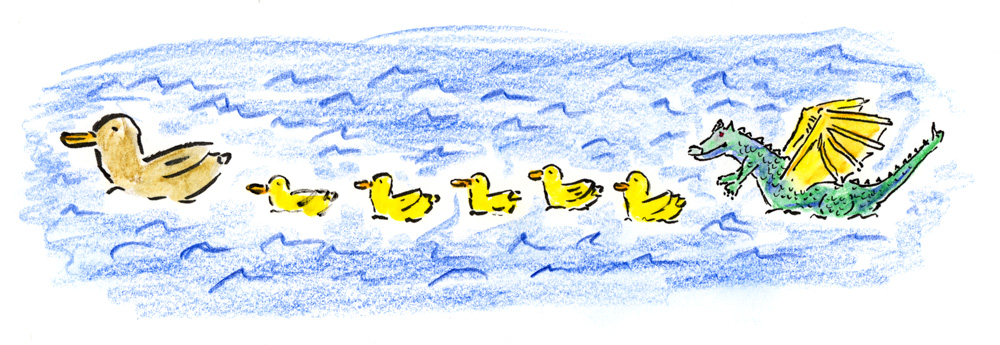
The first five ducklings were yellow and fluffy, and tumbled over one another like little yellow powder puffs. The sixth duckling was different. In place of downy feathers she had shining blue-green scales. Her eyes were like shining red jewels, smoke drifted from her nostrils, and her wings were golden but shaped like the wings of a bat. Even Quack, looking at her sixth duckling, could not fail to notice she was a little odd.
Say what you like about Quack, but she was a good mother. On seeing her seeing her six new hatchlings, Quack said to herself “These are all my ducklings, and I will love them all equally”. She called the six ducklings to attention and solemnly lead them in procession down to the pond. The sixth duckling did her best to waddle behind the other five. She landed with a splash in the pond, and a small cloud of steam rose about her as she paddled behind the other five.
Now, whilst this was happening, many miles away, in an eyrie high in the wall of a sheer cliff face, overlooking the ocean, a dragon was crying. The dragon sobbed huge, jewel-like tears the size of duck eggs. As each tear fell from her ruby eyes and hit the rocks below it shattered into a thousand sparkling fragments, to be followed a second later by the next tear.
The dragon was sad because she had lost the thing that she cared for most in the whole world: her beautiful, precious egg.
The way it happened was this: the dragon was returning to her nest from hunting for cabbages one afternoon (dragons love cabbages), when she saw an eagle perched in her eyrie and pecking at her egg. She roared, and swooped down on startled eagle, spraying flames as she went. The eagle grabbed the egg in its talons and flew off as fast as it could, with the dragon giving chase. The two creatures raced for miles, swooping over the tops of trees, circling and then soaring above the clouds, until, exhausted and with its tail-feathers smouldering, the eagle dropped the egg.
The poor dragon watched helplessly as the egg tumbled through the clouds and disappeared from view. For days and weeks afterwards she searched high and low for any trace of the fallen egg, until, convinced that it must have broken into a thousand pieces, she returned to her eyrie to weep.
But the egg didn’t break. It’s fall was slowed by a bunch of tall reeds and, miraculously, it landed unharmed in a waiting duck’s nest.
Back at Quack’s nest, things were not going so well for the sixth duckling. At first the five feathered ducklings had been very happy to have such an unusual and different sister. When a fox had come sniffing around their nest, looking for easy pickings, it had quickly run away with its tail between its legs. And when another family of ducklings had tried to make fun of Quack and her brood down at the pond, the sixth duckling had chased after them with sparks flying from her nostrils, so that they fled in terror, floundering and flopping, with stubby wings splashing wildly in the water.
But every day the sixth duckling grew bigger, till there was no room for both her and her siblings in the nest. She didn’t like to eat duckweed or the small fish that swam in the pond, but was always hungry for larger, stranger kinds of food. Worse yet, she caught a cold from spending so much time in the pond, and every time she sneezed she set the nest on fire. Poor Quack had to beat out the flames with her wings which were soon singed and black with soot.
Quack reluctantly came to a decision: for the sake of the other five ducklings, she must let the sixth, odd duckling go. Sorrowfully she told her ducklings the news. She gave her sixth duckling one of her tail feathers to remember her by. The other ducklings gathered round offering goodbye hugs and pecks. One single tear fell from the sixth duckling’s eye, and lay, shining like a perfectly cut diamond, on the ground.
And so the strange little duckling with blue-green scales, ruby-red eyes and golden wings set out on her way. First she crossed the pond, and then followed the small burbling stream that headed out towards the neighboring forest. As she followed it the stream it got wider and more sedate, and was joined by more bubbling streams until it seemed more of a river than a stream. Some of the time she paddled along in the water, as her mother had taught her, but then she would try following her instinct and flying, and with a few beats of her golden wings, she was sailing above the silvery snaking river, watching it winding between the steep banks below.
The first evening she slept in a haystack on a farm that backed on to the river. She was awakened in the early hours of the morning by shouts from the farm house, and was surprised to find the haystack ablaze. She waddled back to the river as quickly as she could. After that she slept amongst rocks, or on bare earth with nothing flammable nearby.
After many days of travel the river opened out into a wide, boggy wetlands through which she could no longer swim. She took to the wing once more, and found herself soaring above the marshland, then the beaches, and suddenly the glorious, wide open ocean.
For many hours the odd duckling flew over the ocean, entranced by the majestic waves and the far horizons, until, tired and hungry, she landed on a small islet. There she found some wild cabbages which she ate, ravenously, and she fell asleep on the sand beneath a swaying palm tree.
In the weeks that followed she flew far and wide over the ocean, every day going a little further and feeling a little more brave. She had many adventures: she had tea with mermaids (though the tea tasted of seaweed); she played checkers with an octopus (though the octopus always won); and she flew above the clouds with an albatross (though the albatross kept complaining that ancient, grey bearded mariners were taking pot shots at him). And every day she grew a little bigger and a little stronger.
Some weeks later, flying further than she ever had before, the odd duckling came to a range of high cliffs and landed on the rocky beach at the cliff’s base. From high above she could hear the sound of sobbing, and a tinkling that sounded like crystals or jewels breaking on the rocks above.
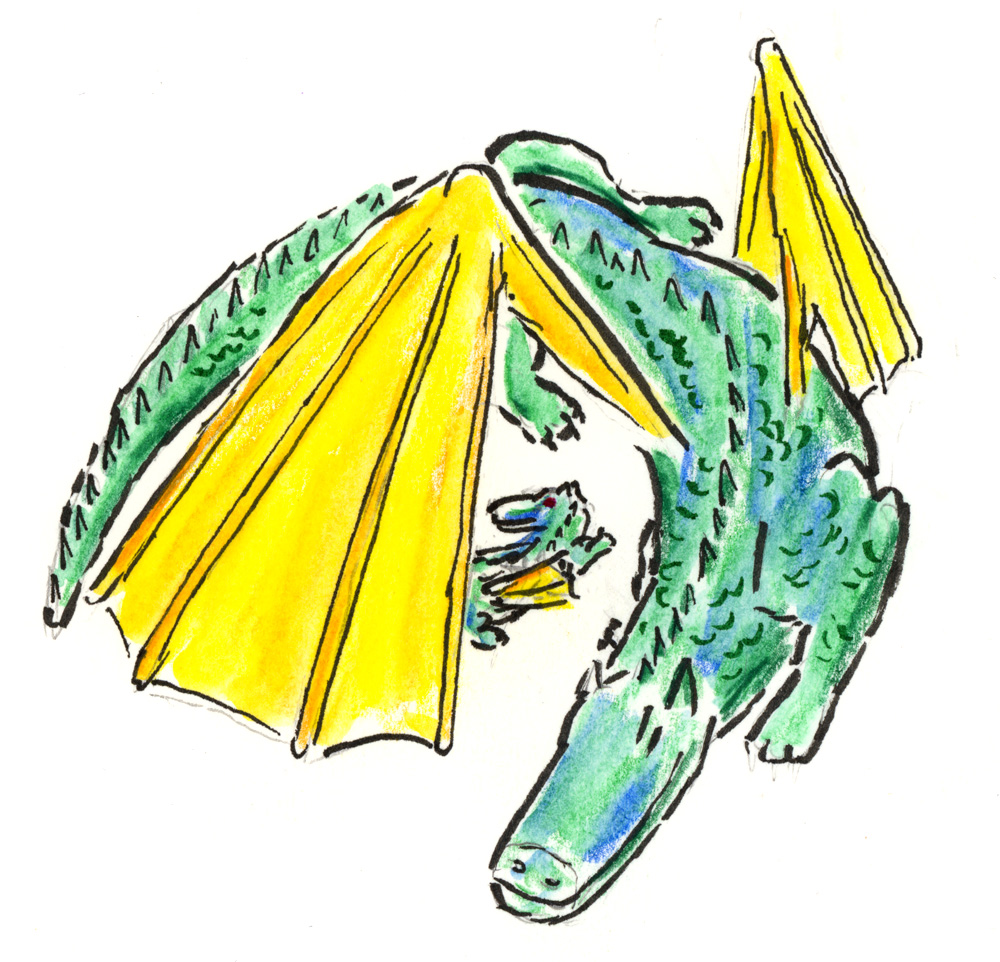
The duckling was curious and flew up searching for the source of the sounds. She found a ledge, high up on the cliff face, and on the ledge was a creature bigger than any the duckling had seen before. In spite of its size, the creature looking familiar, much like the reflections the odd duckling and seen in the pond long before. It had huge red eyes of flame, was covered with shining blue-green scales bigger than dinner plates, and its great golden wings unfolded to caste a shadow bigger than the biggest thunder cloud.
“Hello,” said the odd duckling. “Why are you crying?”
The creature stopped, and stared at the duckling in surprise and wonder. “Who are you?” it asked after a long pause.
“I’m a duckling,” said the odd duckling. “At least I think I am,” said the odd duckling. “Though sometimes I’m not sure”, she added doubtfully, and she proceeded to tell her long and strange story.
As she talked the creature’s eyes grew bigger and wider, until finally the odd duckling stopped and looked up at the huge creature which starred at her in wonder.
“You’re not a duckling, you are a dragon,” said the creature, “and you are my baby!” With that the mother dragon wrapped her huge, golden wings around the baby dragon, and as she hugged her tightly, her heart filled with joy.
From that day on the baby dragon lived with her mother, and she grew ancient and huge and wise, the way that all dragons do.
Friday, September 16, 2016
The Rabbit In The Moon
A Traditional Folktale from Japan
A Note on the Translation:
I made the Moon-with-rabbit above as a contribution to the birthday present for a friend, and wanted an authentic version of the story of The Rabbit In The Moon to go with it.
Variations of the story of the Rabbit in the Moon exist in many Asian cultures. In some versions the Old Man of the Moon is replaced by the Jade Emperor (Chinese) or Sankra the God of the Heavens (Indian). In some versions the additional animals change, for example a monkey, an otter and an jackal. A version of the story is included in the Konjaku Monogatarishū, a collection of Japanese stories from the Helen period.
As is often the case with historical folk tales and fairy stories, contemporary translations and retellings have often been altered or sanitized to fit better with modern sensibilities and ideals. Despite extensive research, I was not able to find a modern translation of the story which satisfactory captured the original intent. Consequently I have provided a new translation which attempts to better capture the spirit of the earliest Japanese versions of the story.
(Note: May not be suitable for younger readers)
Long ago in Japan a monkey, a fox and a rabbit all lived together and were best friends.
Now the Old Man in the Moon looked down from the sky and wondered at how kind and gentle the three animals were, and he wondered which of the animals is the kindest. One day he determined to find out, and so he came down to earth and disguised himself as a beggar.
“Please help me,” said the beggar to the three animals, as they gathered around a fire, “for I am very hungry.”
“Certainly we’ll help you,” said the monkey, the fox and the rabbit.
First the Monkey went and gathered all kinds of good fruits and nuts from the trees and laid them at the feet of the beggar. “I can offer you these fruits and nuts,” he said.
Then the fox went and caught a large, tasty fish and laid it and the feet of the beggar. “I can offer you this fish,” he said.
But the rabbit could only gather grass which the beggar could not eat, and had nothing to offer.
When the rabbit’s turn came, the beggar looked at him expectantly, then at the fire, and then back at the rabbit. The fox licked his lips. The monkey started to chatter excitedly.
“No Way! That’s fucking bullshit!” said the rabbit. “Screw you, I’m getting the hell out of here!”
Before the beggar, the monkey or the fox could do anything, the rabbit hopped the the rocket-ship that the beggar had arrived in and took off. (Foolishly the Old Man of the Moon had left the keys in the ignition.) The rabbit flew straight to the moon where he lived for ever afterwards. The Old Man was stranded on earth, and was devoured by wolves a short time later.
Now the Old Man in the Moon looked down from the sky and wondered at how kind and gentle the three animals were, and he wondered which of the animals is the kindest. One day he determined to find out, and so he came down to earth and disguised himself as a beggar.
“Please help me,” said the beggar to the three animals, as they gathered around a fire, “for I am very hungry.”
“Certainly we’ll help you,” said the monkey, the fox and the rabbit.
First the Monkey went and gathered all kinds of good fruits and nuts from the trees and laid them at the feet of the beggar. “I can offer you these fruits and nuts,” he said.
Then the fox went and caught a large, tasty fish and laid it and the feet of the beggar. “I can offer you this fish,” he said.
But the rabbit could only gather grass which the beggar could not eat, and had nothing to offer.
When the rabbit’s turn came, the beggar looked at him expectantly, then at the fire, and then back at the rabbit. The fox licked his lips. The monkey started to chatter excitedly.
“No Way! That’s fucking bullshit!” said the rabbit. “Screw you, I’m getting the hell out of here!”
Before the beggar, the monkey or the fox could do anything, the rabbit hopped the the rocket-ship that the beggar had arrived in and took off. (Foolishly the Old Man of the Moon had left the keys in the ignition.) The rabbit flew straight to the moon where he lived for ever afterwards. The Old Man was stranded on earth, and was devoured by wolves a short time later.
Subscribe to:
Comments (Atom)