Tuesday, January 5, 2021

Making a Toy Gyroscope on a Mini-lathe - Part 1


(Change of pace for this post.)

Last year I bought myself a Chinese-made mini-lathe (SIEG C3) to play with, similar to the small metal-lathe my father still has in his workshop. I've been doing a few small projects on it, including some spinning tops and simple tools, and decided to try making some toy gyroscopes.


I was inspired by the toy gyroscopes I had when I was a child: you would up a piece of string round the spindle and pulled to get them spinning. They used to come with a little plastic "Eiffel tower" that you would balance them on. I wanted to make something a bit more "serious" than those.

Prototypes

I went through a series of prototypes, starting with some 1 1/2" diameter brass rod. My first attempt didn't have nearly enough angular momentum, so I switched to using much thicker slugs of brass. For the last prototype I bought a piece of 2" brass rod on ebay to use. I also decided they needed an outer cage to allow them to keep spinning when held.


Prototypes

I tried various bearing options, including a simple point-and-cup bearing, miniature thrust bearings and regular cartridge ball bearings. In the end I find that the 1/4" ball bearings purchased from VXB worked best (about $3 each).


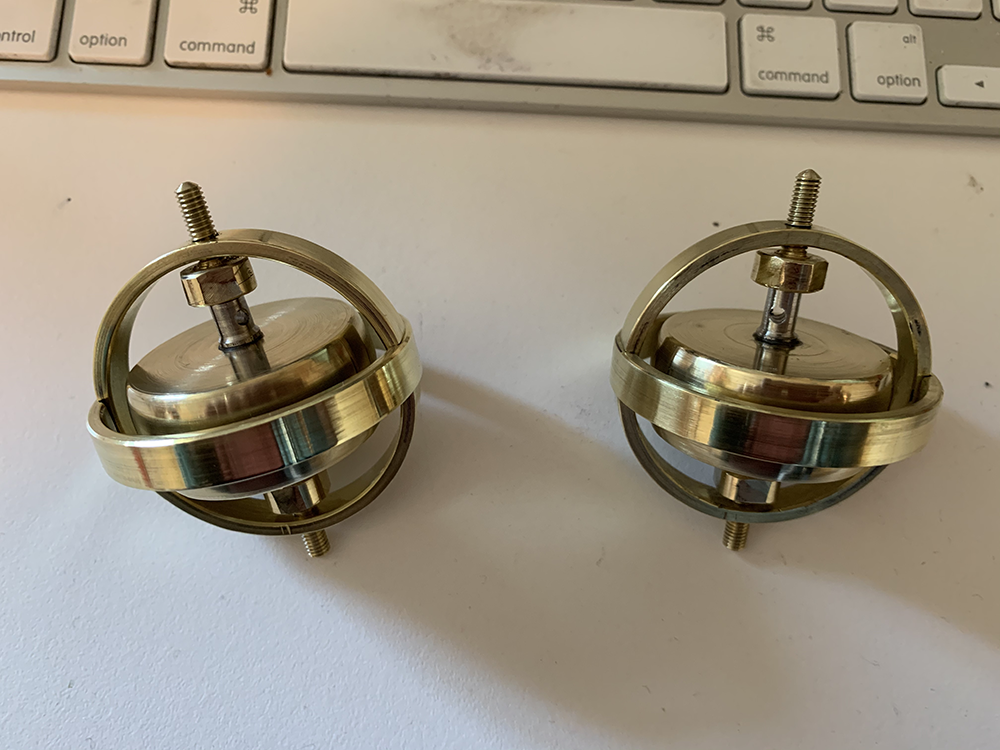
This page show the final version I made for my brother's birthday, using a 2" diameter flywheel. I also made a couple of smaller ones for my daughters for Christmas:


Raw materials

The raw materials were:

  • 2" diameter brass round bar for flywheel

  • 2 1/2" OD brass pipe for cage

  • 3/8" brass bar for bearing cups

  • 1/4” stainless rod for spindle

  • 2 X .25" OD/.125" ID bearings


(Note, the dimensions for materials are in inches since that's easier to order in the US. All my working measurements are in metric however, which is much easier to actually work with.)

Part 1: The Cage


The cage is probably the hardest part to make. It consists of two brass rings with notches filed in them to snap together. The inner ring is drilled and threaded for the bearing cups.


First cut two rings from the brass pipe:


Next, face the sides of the two rings and turn them down to 8mm width. Make sure the sides are parallel:


Turn the outside of the pipe off to make it round and get a nice finish:

Now switch to the outside jaws on the chuck, and bore out the inside of the rings to the desired thickness (I did 2.5mm).

Optionally curve the outside surface of the rings. For this switch back to the inside jaws and set the compound to a small angle (5-10 degrees). Finish with a file and emory paper:


Next we need to drill and tap the holes in the inner cage for the bearing cups (M4). It’s important to get these correctly aligned. This could be done with a drill press if you’re very careful, but I found it better and more accurate to drill and tap on the lathe using a 4-jaw chuck:


I also used a tap-follower, which I had made for the purpose, to make sure the tap was straight. You can buy them of course, but they’re easy to make and a nice side project.
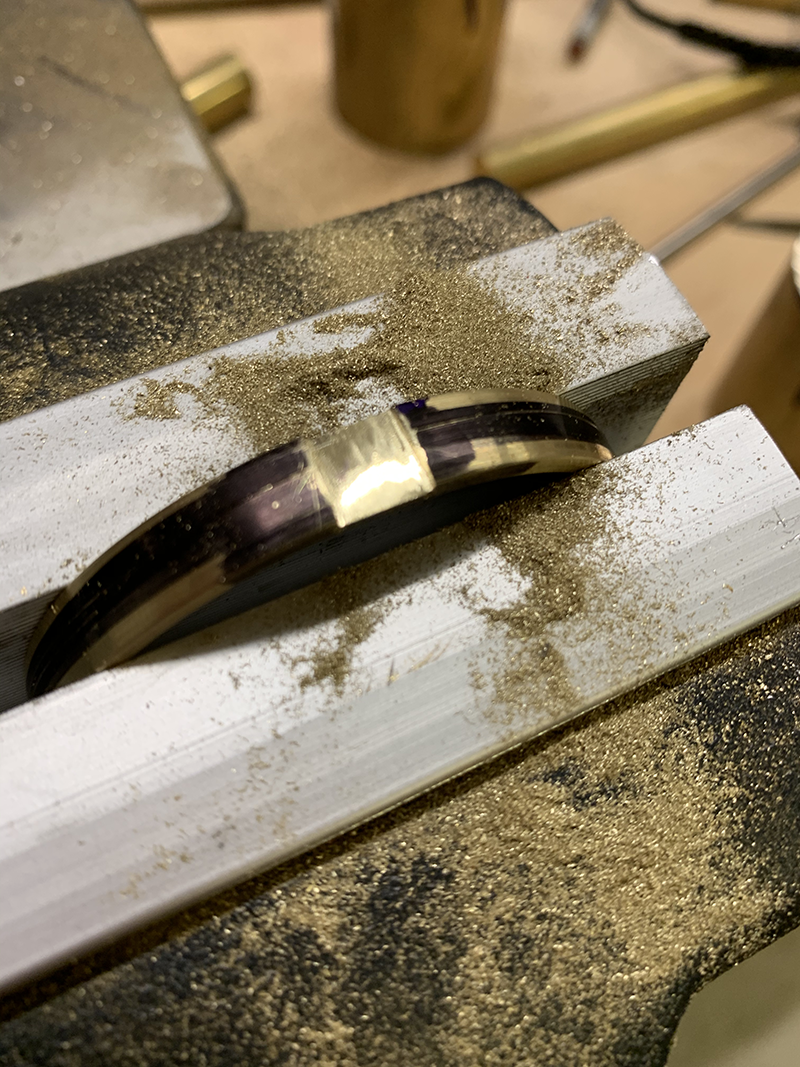
Finally we need to file notches in the two rings to make them fit together. These should be the same width as the rings (in this case 8mm) and slightly less than half the thickness of the rings, so that the rings are squeezed/stretched when together. The notches on the inner ring should be 90 degrees from the holes. The sides of the notches on the outside ring should be sloped slightly as they will go in when the ring is squeezed.


We can do a test assembly to make sure the parts fit, and make adjustments if needed.


Put the outer ring in a vise and squeeze until it’s just wide enough to fit in the inner ring:


Continued in ..

(the spinny bits...)

Sunday, June 21, 2020

The Golden Hedgehog

Once there was a Golden Hedgehog.

He had prickles of gold which glinted in the sun. His fur was also golden, and even his snuffling nose was gold.


He lived in a forest, and, in other respects, he was much like any other hedgehog (other than weighing rather more). He ate a well-balanced diet of slugs, worms, bugs and other yummy creepy crawly things. He slept in a hollow lined with moldy leaves. In winter he would curl up and hibernate, and would emerge in spring, well-rested but hungry, and start searching for slugs.

He was quite easy to spot, even amongst the thick undergrowth of the forest. But still, the hawks and the foxes and the other creatures that hunted in the forest would leave him alone, because, golden or not, his prickles were, well, prickly. The other hedgehogs in the forest did not treat him any differently or pay his golden prickles much mind. Hedgehogs are a very open and accepting lot.

Now one day an Emperor was taking a walk in the forest. He had a large retinue that followed him wherever he went, and fauned on him constantly. He noticed the glint of gold in the bushes and told one of his servants to investigate.

The servant returned. “It appears to be a golden hedgehog, your Eminence,” he said.

“Bring it to me,” said the Emperor. “A golden hedgehog must be lucky. With it I will have great fortune and riches!”

“But, Your Magnificence, you already have great fortune and riches,” said the servant.

“No matter,” said the Emperor, “with a golden hedgehog I will have multitudes of grand palaces and castles!”

“But, Your Awesomeness, you already have multitudes of grand palaces and castles,” said the servant.

“With it, I will rule over the whole land, and all will bend to my will!” said the Emperor.

“But, Your Superlativeness,” said the servant, “you already rule over the whole land, and all do bend to your will.”

“Enough!” cried the Emperor. “The golden hedgehog must be mine! Capture it and bring it to me.”

The servant found a cardboard box, and with the aid of a nice juicy slug as bait, he got the golden hedgehog into the box and followed the Emperor back to the palace. (Of course he poked some air holes in the box first, and lined it with soft leaves.)

When he returned to the palace, the Emperor looked at his crown of gold and jewels, which suddenly seemed dull and ordinary compared  to the wondrous hedgehog. “Destroy that,” he said. “I will have a new hat made, so that I can wear the golden hedgehog as a crown.”

And so it came to pass. The Emperor wore the golden hedgehog as a crown as he ruled. When foreign dignitaries or princes visited, asking for trade, he would sneer at them. “What would we want from your puny land? Does your ruler wear a hedgehog of gold?” he would say.

Unfortunately, like most hedgehogs, the golden hedgehog had fleas. In fact, because they had to bite through the hedgehog’s golden skin, the fleas that lived on it had developed particularly strong and powerful bites.

Soon the Emperor’s head was itching uncontrollably. Then his neck, and his back and chest started to itch. Before long the Emperor’s whole body was itching. He was too proud to take off the hedgehog, or to admit that he had fleas, and so he started to scratch and fidget constantly, even during important meetings and state banquets. Those who saw him thought their emperor must have some grave malady and started to wonder if he was fit to rule.

Worse still, the Emperor was constantly distracted by the itching, and unable to think clearly. When asked to make a decision, he would blurt out the first thing that came into his mind. When the farmers came to tell him their crops were failing, he told them to plant daffodils instead. When the city planners told him the roads needed repair, he said “Dig a tunnel underneath”. When the treasurer told him that merchants weren’t paying their share of taxes, he said “just tax the poor.”

There was discontent throughout the land. Soon enough the muttering turned to protests and the protests to a popular uprising. The Emperor was deposed and forced into exile in New Jersey. He fled the palace wearing only his pajamas, and leaving the golden hedgehog behind. In his place, the people created a new democratically elected parliament, who quickly established mutually beneficial trade agreements with neighboring countries, and built a new social welfare and public education system. The country became prosperous and the people were happy.

With no further attention being paid to it, the golden hedgehog left the palace and spent the rest of its years living in the palace gardens, which soon became unkempt and overgrown, and were home to many particularly tasty slugs.


Tuesday, May 12, 2020

The Tigers, the Crocodiles and the Grandmother

I found this while looking through my Google drive at some half-finished stories. I wrote it a while ago, and put it aside with the intention of drawing some illustrations to go with it. Perhaps I still will sometime, but, since I haven't drawn any yet, I figured I should just post it as it is.
At the time, I did send it to my parents and my mother seemed to like it a lot. I think she thought it was about her, but I'm not quite convinced myself. 

Once upon a time there was a grandmother.

She was a ferocious and brave grandmother, in the way that grandmothers can be.

When she stood straight it was as if she had a steel rod in her spine. When she walked it was with big, purposeful strides. (She walked with a cane, but it was mostly for effect since she didn’t need it for balance.) She had a way of looking at people over the top of her half-moon spectacles that could make even a grown man’s knees turn to strawberry jello.

The grandmother lived next to a forest, and her granddaughter lived on the other side. It was a Dark and Dangerous Forest. There were many Wild Animals: tigers and crocodiles and rodents-of-unusual-size. The last time her granddaughter had visited she had met a wolf, who had caused endless problems. But, of course,  grandmothers do not know the meaning of the word fear…

One spring morning the grandmother decided it was time to visit her granddaughter. She packed her purse with a ball of yarn, two knitting needles, a box of peppermints,  a handkerchief, a thermos of tea and a packet of digestive biscuits. She checked that the stove was turned off, put out food for her cat, picked up her cane, locked the door of her small, cozy cottage, and set off into the Dark and Dangerous Forest.

It was a cool morning, in early spring. The grandmother had not bought a shawl and was feeling the morning chill. After walking a little while, she sat down on a log, took out her needles and yarn and started knitting. Fifteen minutes later she stood up to assess her work, gave a curt nod of approval, and, wrapping a new, pink, fluffy shawl around her shoulders she continued on her way.

At the edge of the forest two tigers lay in the sun. The first flared her nostrils. “I smell something coming,” she said.

The second tiger jumped to the top of a rock and looked out. “It’s a strange animal walking on its hind legs,” she said. “It looks tasty,” she added.

The two tigers crept silently towards the grandmother, invisible in the tall grass that grew along the edge of the forest. The smaller tiger circled round behind her to block her escape. Then the tigers emerged, their lips curling back to reveal their enormous, razor sharp teeth, their sinews tightening as they crouched back on their hind legs, ready to pounce.

“Yes?” said the grandmother, “What can I do for you?”

“You can prepare to be EATEN!” said the larger tiger with a blood curdling snarl.

The grandmother looked sharply at the tiger over the top of the spectacles perched on the tip of her nose. “That,” she said, “is NOT a polite way to talk to an old lady.”

“Oh,” said the tiger, feeling rather confused. “...um ...I mean, er, would it be ok if we ate you, please?”

“Certainly not!” said the grandmother. “I didn’t go through all this trouble just to become kibble for a pair of overgrown cats with teddy-bear ears. The very idea!”

“Oh, um, well…,” the first tiger trailed off and turned its head away, no longer able to meet her gaze.

“And you,” said the grandmother, turning her withering look on the second tiger, “What do you have to say for yourself?”

“Oh, well…, um..., it’s just that we were terribly hungry you see,” she said lamely, and looked away.

“Yes,” added the first tiger, “all we’ve eaten since breakfast were two bison and an antelope, and... well... we just thought,...” Her voice trailed off.

“I see,” said the grandmother. “You may have one peppermint each, but that’s all.”

“Oh, thank you very much,” said the two tigers together.

The grandmother pulled the tin of peppermints out of her bag, and handed one to each of the tigers. The tigers quickly left for the forest, to warn the other creatures of the strange and frightening animal that was its way.

As she continued on her way, the grandmother heard murmurs in the forest around her. A pair of big-eyed lemurs peaked out from the high branches above, and whispered to one another that this was the strange creature that had frightened the terrible tigers. A snake hissed and slithered further up its tree for safety. Some monkeys put an offering of bananas on the ground ahead of her, to try make sure they were in her good graces, and swung away quickly as she approached.

The grandmother stopped and sat on a low rock to drink some tea.

A wide, muddy river ran along the far side of the forest. The river was home to large crocodiles with evil smiles who spent their days lying in the water pretending to be logs, and to logs that spent their days lying in the water pretending to be crocodiles. The crocodiles took little interest in the forest creatures, other than wondering about their nutritional value, and did not listen to their chatter.

When the grandmother reached the bank of the river she looked upstream and downstream. There was no safe place to cross. “Hmmph,” she thought. “I shall need a bridge. I’m certainly not going to spoil a pair of perfectly good shoes and socks wading through this.”

She noticed that the log nearest the bank had an unblinking yellow eye watching her. “You,” she said, nudging the log with her stick. “Time to make yourself useful.”

“Yeess?” said the crocodile, raising its head from the water and revealing its mouth full of jagged, ugly-looking teeth. “How may I be of ssservice?”

Two more crocodiles swam up, and looked her up and down, showing their ghastly smiles. “I wonder what this isss,” said one of them. “Not much meat on it,” said the other. “But ssoo sssuuculent,” said the first.

“That’s quite enough of that!” said the grandmother, giving each of the crocodiles a sharp wrap on the nose with her cane. “I’ve no intention of being eaten by you or anyone else today. Is that clear?”

“Yess ma’am. Ssorry ma’am,” the three crocodiles muttered, their smiles fading, and being replaced by more glum expressions.

“Now you,” she said, pointing to the first crocodile, “swim over there with your nose to that bank.”

“You,” she said, pointing to the second, “in the middle, with your nose to his tail.”

“And you,” she said to the third, “turn around with your tail pointing this way. Quick about it! I haven’t got all day.”

“Yess ma’am,” said the crocodiles, and, grumbling to one another, they lined themselves up, nose-to-tail across the river. The grandmother stepped onto the tail of the nearest crocodile, and nimbly trotted along their backs, while the crocodiles were still trying to think what to do.

“Now,” she said, turning back to look at her makeshift bridge, “thank you for your assistance.” She gave each of the crocodiles a digestive biscuit.  “And we’ll have no more of this talk about eating little old ladies,” she added. “Understood?”

“No ma’am,” said the crocodiles sullenly, and they swam away munching their biscuits.

It was almost lunch time when the grandmother reached the cottage where her granddaughter lived, and knocked on the door.

Her granddaughter had just finished packing a basket with food, and was putting on her favorite red cape and hood, when she opened the door. “Oh Grandma,” she said, giving her a warm hug, “I was just coming to visit you.”

“I know dear,” said the grandmother, “But it was such a nice day, and I didn’t want to put you through any trouble. Besides, I do need the exercise.” She looked at the basket. “Oh good,” she said, “I’m just in time for a picnic.”

Saturday, February 1, 2020

The Old Oak Tree


Once there was an old, old oak tree. It was tall and broad; its branches were twisted and gnarled; its bark was bumpy and knotted.

It stood in the middle of a small forest, which the animals who lived there called simply  “The Forest”. The old oak was by far the biggest and tallest tree in the forest. The animals called it simply “The Oak Tree”. It had been there as long as any of them could remember. It had been there as long as their parents, grandparents and great grandparents could remember.

The oak tree looked after the animals of the forest. Its branches provided shelter from the rain in spring and the heat in summer. Its fallen leaves kept the earth warn and lined the burrows and nests of the animals in autumn. Its acorns fed the chipmunks and squirrels through the cold winters.

In the high branches of the oak tree, an old Great Horned Owl had found a nest and moved in, while, a little lower, a starling had made her nest and raised her chicks, A chipmunk lived in a hollow near the base of the tree, which she filled with nuts and acorns to last the winter. And, amongst the oak tree’s roots, a fox made a den for herself and her family of cubs.

The animals would not hunt or chase each other beneath the branches of the old oak tree, for they knew it was a special place. They would walk slowly by, greet each other politely, and sometimes would nod to the oak tree. Even the fox would stop to say “good evening” to the smaller animals as she left for a night’s hunting.

The oak tree’s roots spread far and wide throughout the forest, for they had had many years in which to grow and spread. Through them the oak could sense much of what went on in the forest. In the spring it would feel snow melting, and the new life of the young plants that burst from the ground. In summer it would feel the earth dry and crack. In autumn it felt the warm leaves cover the ground, and the paws of the animals as they scurried back and forth, gathering food for the winter. And in winter, as a blanket of snow covered the ground, it felt the cold and the stillness that spread throughout the forest.
And so the years passed. The oak tree became older still, and, in its way, it thought and considered and pondered, until one day, as summer was coming to an end and the leaves of the forest turned to red and brown and gold, it thought to itself “It is time”.

The oak tree dropped a single acorn in front of the fox’s den. “Please take this acorn,” it said to the fox, “and plant it at the edge of the forest where the stream runs.”

The fox was proud to be asked to do such an important task. She took the acorn gently in her mouth and set out, with her tail held high.
She had been walking for some time when the fox picked up the scent of a young rabbit, and stopped, trying to decide what to do. “If I leave the acorn here the squirrels will get it,” she thought. “But I need to find food for my cubs. If I miss the rabbit I might not get another chance.”

Just then the starling landed on the branches of a tree, just above the fox. “What are you doing?” she chirped. The fox explained about the acorn she had promised to plant, and the rabbit she needed to hunt. “I can take it,” said the starling. “I’ll fly it there”.

The starling swooped down, picked up the acorn in her claws and headed out to the edge of the forest where stream bubbled and burbled. Landing by the banks of the stream, she started to scrape and peck at the earth.

The chipmunk appeared, emerging from the undergrowth, and asked the starling what she was doing. “I’m trying to dig a hole for this acorn,” she said, and explained about the old oak tree and the fox.

“Let me help,” said the chipmunk Together they dug a small hole, placed the acorn in in it, and covered it with earth. Then the two returned to the old oak tree together.

Soon enough winter followed the autumn, and soft snow covered the ground. All the forest seemed to sleep, awaiting the arrival of spring. The snow melted, and the forest creatures emerged from their winter’s sleep.

The horned owl, flying over the edge of the forest, saw the leaves or a young oak sapling, and returned to the old oak to tell it what she’d seen. The oak felt content.

As the year passed the owl continued to fly out to the edge of the forest, and report back. The old oak listened to all that the owl told it, and it reached out with its roots towards the sapling, and it waited.  By the time winter came again, the young oak was already as tall as the deer that would come to drink from the stream.

The following spring, the young oak was taller still, and started to reach out with its own roots, exploring and searching. The old oak tree waited. A small robin landed on the young oak’s topmost branches  and sang a song to welcome the spring.

As the spring turned to summer, and the summer to autumn, the young oak’s roots spread further until, just before the first flakes of winter snow started to fall, they touched and entwined with the roots of the old oak tree. It seemed as if a change came over the old oak, as if it had found something it had been waiting for a long time.

Throughout the winter the old oak told stories of the forest; of the plants, and the bees that carried pollen from one flower to the next; of all the animals from the mighty stag that had once run through the forest, to the tiniest beetles; and of the eb and flow of the seasons. The young sapling seemed to absorb these stories, as it absorbed the water and food from the earth. When spring came again, it seemed to those who saw it, that the young oak stood taller and straighter than before, as if it had a purpose now, and knew what must be.

And so the years passed, the forest spread, and the young oak tree grew tall and broad. In time it became taller than all the surrounding trees. One of the cubs of the old fox decided to build her den amongst its roots, and there raised her own cubs. A hawk built a nest in the high branches, and, when it left, a young great horned owl took up residence in its place.

Soon enough the animals became used to having two oak trees to look after the forest, sheltering them from the rains of spring and the heat of summer, giving them warm leaves to line their nests in autumn, and acorns to feed them through the winter. Perhaps none could remember a time when there was just one oak tree.

But still, the animals would always call the oak that grew by the stream “The New Oak Tree”. To them the older, gnarled and knotted tree that stood deep in the center of the forest was always simply “The Oak Tree”.

Tuesday, January 7, 2020

The Wizard's Hat


There was once a Wizard. He lived in a small town by the sea where he owned a wizarding shop. There  was a sign over the door with “Wizard” painted in gold, curly letters. Inside the walls were lined with dusty shelves, overflowing with ancient books, and jars of spells and potions. The floor and ceilings were covered with strange, mystical symbols - pentagrams and octograms and other-sorts-of-grams. The Wizard himself lived in some small but well-appointed rooms above the shop.

The Wizard was, for the most part, everything you might expect a Wizard to be. He had thick, bushy eyebrows, and a beard that flowed down to his waist. He had a wand that glowed blue in the dark and left a trail of sparkles when he swished it, and his robes were long, the colour of midnight, and embroidered with hundreds or silver stars and moons. His hat had a wide brim and would have, been tall and pointy, but, and it was a big BUT, the point always flopped over.

Of course this is a big deal for a wizard. You wouldn’t go to a wizard without a pointy hat, and neither would I. When he walked down the street, children would laugh behind the Wizard’s back, and throw stones at him, not being the least worried that he would turn them into a newt, or a duck, or a bowl of clam chowder.

The Wizard tried everything he could think of to make the point of his hat stand up: he starched it; he stuffed it with straw; he reinforced it with sticks and cardboard, but all to no avail. No matter what he did, his hat would not stay pointy.

One day, while the Wizard was sitting behind the counter of his shop drinking green tea, the  mail arrived. There was the usual collection of bills and catalogs, but, at the bottom was an invitation to sit on a panel on advanced disenchantments at the Annual North-East Regional Wizarding conference the next week. At first the Wizard was very excited. The conference was always a great place to see the latest wizarding parapharnalia, try out new beard-conditioning products, and catch up with old friends and colleagues, and to be invited to take part in a panel would be an honor. But then he hesitated; how could he take part when the point of his hat flopped over so. Sadly he decided he would have to decline the invitation.

Feeling despondent, the Wizard decided to go for a walk in the enchanted forest that bordered the town (in those days there were many more enchanted forests, and fewer enchanted shopping malls about). As he walked he tried to imagine what other wizards would say, seeing his floppy hat, and how he could possibly attend and be taken seriously.

After he had been walking for a little while, the Wizard heard a sound of crying through the woods. He followed the sound till he came to a grass-covered glade. In the middle of the glade lay a white unicorn with rainbow tears flowing from her eyes.

“What’s the matter?” asked the Wizard. 

“My hoof hurts,” sobbed the Unicorn.
“Let me look,” said the Wizard. He came closer and examined the beast’s hoof. “There’s a stone in it. I’ll soon have it out,” he said.

He took out his special edition wizard’s swiss army knife (one big blade, one little blade, scissors, bottle opener, and a miniature, telescoping wand for emergencies) and removed the stone.

The Unicorn jumped up and started prancing round the glade. She popped a passing bubble with her horn. (Most evolutionary biologists believe that unicorn horns are a means of defence, but, the truth is, they evolved them solely for the purpose of bursting bubbles, which is a favorite pastime of unicorns.) She tossed her head and whinnied.

After a little while the Unicorn paused and looked at the Wizard. “You look sad,” she said. “What’s the matter?”

The Wizard explained about the Annual North-East Regional Wizarding conference, and about his floppy hat.

The Unicorn thought for a minute. “You know,” she said, “we unicorns lose our horns every winter, and grow new ones in spring.”

“Of course,” said the Wizard who had studied unicorns and other mythical creatures in wizarding school (but didn’t understand about the bubbles.)

“I think I still have my horn that fell off last winter,” she said. “We could try that.”

The Unicorn left the glade, and returned a few minutes later carrying a large and very pointy horn in her teeth.

We the help of the Unicorn and a roll of duct tape, the Wizard fastened the horn to his head. He put the hat over it. The point stood up, sharp and true. The wizard returned home with a spring in his step, to admire himself in the mirror.

And so, the following week, the Wizard attended the Annual North-East Regional Wizarding conference. He examined the latest wizarding paraphernalia. He tried out several new beard conditioning products, but decided to stick with his old standby. He spoke eloquently and authoritatively at the panel on dissenchantments. And, at the end of the conference, after the awards for most-innovative new spell, and for special services to wizarding where awarded, the organizing committee presented him with the annual award for pointiest hat.

The Wizard proudly carried the trophy back to his shop, and placed it on the shelf behind the counter, between the books on dragon-calming and invisibility spells, so that it would be the first thing that anyone coming into the shop would see.


Friday, October 18, 2019

The Emperor and the Bird

A long time ago in a land far away, there lived a small bird.

She was nothing special to look at. She had a small pointed beak, black eyes that moved constantly, and her feathers were brown and ordinary. She lived in an ordinary looking nest, in an ordinary looking tree. But she had the most beautiful voice in the whole forest.

Sometimes the little bird would watch the bright blue jays and scarlet cardinals flitting from tree to tree, and she would wish she were as brightly coloured as them. Then she would sing a sad song, and all the forest creatures who heard her, the foxes and stoats, the chipmunks and field mice, would feel their hearts fill with mourning, and would cuddle up with their young in their nests and burrows.

Sometimes the bird would watch the sunrise over the forest, and she would sing a song of joy at it’s beauty and splendor. Then the forest creatures would play and frolic in the fields, and they would go about their days with their tails held high and their ears pricked up, full of excitement about the coming day.

Sometimes the bird would watch the sunlight glinting of the towers of the palace in the distance, for in those days the land was ruled over by a great and wise Emperor, and his palace was magnificent, with gardens full of fountains and blossoming fruit trees. Then she would sing songs of wonder, and the forest creatures would stop and gaze into the distance, their hearts full of curiosity and wonder at the world.


Now it came to pass that one day the Emperor decided that it was time to appoint a new High Chancellor: “For I am getting old,” he said, “and the work of an emperor is hard. I need help to rule justly and fairly”.

Of course all his officials, advisors and noblemen argued that they should get the job. They all came before him, flattering and obsequious, deriding their rivals and making cases for why they should be they should be the new High Chancellor.

“Very well,” said the Emperor, for he quickly tired of such flattery and noise. “In one month, any who wishes to be my High Chancellor may bring a bird to me in the Imperial Gardens. He who brings the bird that pleases me most will be my new High Chancellor.”

At once all the advisors left to find the most fantastic birds they could. Some went to the markets to buy the rarest birds they could: bright yellow canaries, scarlet macaws, and beautiful peacocks with green iridescent feathers. Some chartered ships and sailed far and wide looking for even stranger birds. One bought back an ostrich from Australia, one a dodo from Mauritius, and one went as far as Norway and bought back a parrot with beautiful blue plumage.

Now in the palace there lived a poor servant boy. He had been born on a farm, but he was lame and his family was very poor and couldn’t afford to feed and clothe him, and so had sent him to the palace to try to find work. There he worked in the kitchens, or ran errands for various lesser noblemen, and, since he worked hard and stayed out of trouble, he managed to get by. Still he watched all the important men and women coming and going from the palace, seeking audiences with the emperor, and wished for more from his life. “If I had a great bird,” he thought, “I could get in to the Imperial Gardens and see the Emperor myself. I would serve him well.” But he could not travel far and had no money to buy a bird from any of the merchants in the town.

And so a month passed, and one day, being done with his chores for the day, the boy went out for a walk in the forests beyond the great palace. As he stood in thought, he saw the small brown bird alight on a branch near him.

“If you were to come with me,” he said, “we could enter the Imperial Gardens of the palace. We might even see the Emperor. For he has decreed that anyone with a bird can come to the palace today, and he will choose whosoever has the bird that pleases him the most tho be his High Chancellor.”

Of course the bird wanted to see the palace and the Imperial Gardens more than anything, and so she flew down to perch on the boy’s shoulder, and together they headed back to the palace.

The Imperial Gardens were alive with the chatter of officials, advisors and noblemen, all clamoring for the Emperor’s attention, mixed with the squarks and cries or a hundred different birds from all corners of the world.


The Emperor walked amongst them looking at each in turn. He saw the peacock with its magnificent tail feathers. “Too showy,” he said dismissively, “it can hardly fly”. He saw the fat dodo, with its enormous, bulbous beak. “Ridiculous,” he said, “How does such a creature survive?”. As he approached the ostrich it put its head in the ground and turned invisible. The lovely plumage of the blue parrot caught his eye, but as he came to look he was surprised to see that it did not move. He prodded it with his finger and it fell off its perch, dead.

And so he went from one bird to another, each more strange and marvelous than the last. But quickly he grew weary, for he found them all wanting, and somehow none pleased him.

The small brown bird watched quietly from her perch on the boys shoulder, wishing that she could be as graceful, or as splendid or as exceptional as these strange and wonderful creatures, and she started to sing a sad and mournful song.

Throughout the gardens, everyone fell silent, their hearts suddenly filled with a longing for things that might once have been, and things that could never be. The old Emperor felt a tear come to his eye.

But then the bird looked out at the blossoming cherry trees and the sparkling fountains, and she sang a different song - one of joy and wonders.

Throughout the gardens, all who heard felt their souls rise up, filled with joy. Suddenly the old Emperor felt the weight of the years of responsibility and lifted from his shoulders, and recalled the joy and vigor of his youth. He rose up tall and straight. “Where is the bird that sings this song?” he said. “Bring it to me.”

The servants and courtiers rushed about, trying to find the source of the song, and finally the boy was bought before the Emperor, the small bird still perched on his shoulder.

First the Emperor turned to the bird. “There is more beauty in your song than all these others put together,” he said. “Please will you come to live in my gardens, and sing your songs for me and my visitors?”.

Then he turned to the boy. “You have shown more wisdom and judgement than all these others,” he said. “You will make a fine High Chancellor”.

And so it came to pass. The boy served the Emperor as High Chancellor for many years, and helped him to rule wisely and well. When the Emperor finally passed, the High Chancellor remained, advising his heirs, until he too grew very old, and the people of the land lived happily in peace and prosperity.


In the Imperial Gardens, the small, brown bird lived out her life, singing her songs. She lived long and had many chicks, each of whom sang just as sweetly as she did. And they too had chicks, so that the air of the gardens was always full of song.

Visitors would come from far away lands to seek an audience with the Emperor, and would walk amongst the Imperial Gardens, and always they would return home telling tales of the splendors and marvels they had seen, but, especially, of the songs of the Emperor’s birds.

Saturday, June 29, 2019

The Very Muddy Hippopotamus

Once there was a very muddy hippopotamus. She liked to spend her days wallowing in her favorite mud hole. She would roll in the mud. She would squish the mud between her toes. She would sing songs about the mud. She only left to go to the river and and drink, or to get food. And, whenever she left the mud hole, she would always be covered, from the tips of her ears to the end of her tail, in thick, gooey mud.

The other animals in the jungle were not happy with the hippopotamus. The birds, the swallows and flamingos, complained that she would get mud on their lovely feathers. The leopard complained that she would get mud on her elegant spots. The tiger complained that she would get mud over his splendid stripes. Even the antelope complained that she would get mud on her silky, fawn fur (before noticing that she was sharing a paragraph with a tiger and promptly being eaten).
What the other animals did not know was that the hippopotamus had a secret: underneath the mud her skin was a bright, shocking pink. Of course the hippopotamus was very shy about this. “If the other animals see that I’m pink, they’ll all laugh at me,” she thought. And so, whenever she left her mud hole, she would make sure she was completely covered in thick, gooey mud.

One day a fairy queen came to the jungle to see how the animals  were getting along.


All the animals complained about the very muddy hippopotamus. The tiger complained about getting mud on his splendid stripes. The leopard complained about getting mud on her elegant spots. The storks and the flamingos complained about getting mud on their lovely feathers. Even an antelope complained about getting mud on her silky, fawn fur. (This was another antelope who was carefully staying at the opposite end of the paragraph from the tiger).

The fairy queen listened to all the animals grumbling, and then she waved her wand to create a magical hippopotamus washer. There were round, whirling brushes that would scrub the mud off the hippopotamus’ sides. There was another whirling brush that would come down from above and scrub the hippopotamus’ back. There were nozzles that would go back and forth, spraying the hippopotamus with warm, soapy water. There were more nozzles to rinse the hippopotamus with clean water, and more whirling brushes with towels attached to dry her off afterwards. There was even a conveyor belt which would carry the hippopotamus between the whirling brushes and spraying nozzles before she knew what was happening. (The fairy queen decided against including the magical under-body hot wax spray).

And so, the next day, when the hippopotamus left her mud hole to go to the river, she stepped onto the conveyor belt and the magical hippopotamus washer started up. Suddenly there were whirly brushes scrubbing her and nozzles spraying her from directions. Before she knew it the mud was all gone and, the hippopotamus was standing, bright pink, in the middle of the jungle.


The poor hippopotamus was so shy and embarrassed that she wanted to run away and hide. But then something strange happened. All the other animals started saying “ooh” and “ahh”. The tiger said how splendid his black and orange stripes would look next to the pink hippopotamus. The leopard said how elegant his spots would be against a bright pink backdrop. The stork said how lovely it would be with her feathers, and the flamingo was particularly impressed. Even the antelope seemed about to say how well pink would go with her silky, fawn fur, except that she was eaten by a lion before she could speak. (The lion hadn’t been mentioned in our story so far because she’d been hiding in the tall grass waiting to pounce the whole time.)

After that things changed for the hippopotamus. She would still spend most of her days wallowing in her favorite mud hole. She would still roll in the mud. She would still squish the mud between her toes. She would still sings songs about the mud. But now, whenever she left her mud hole, she would jump onto the conveyor belt of the magical hippopotamus washer, and then she would parade about the jungle, bright pink and as happy and proud as can be.